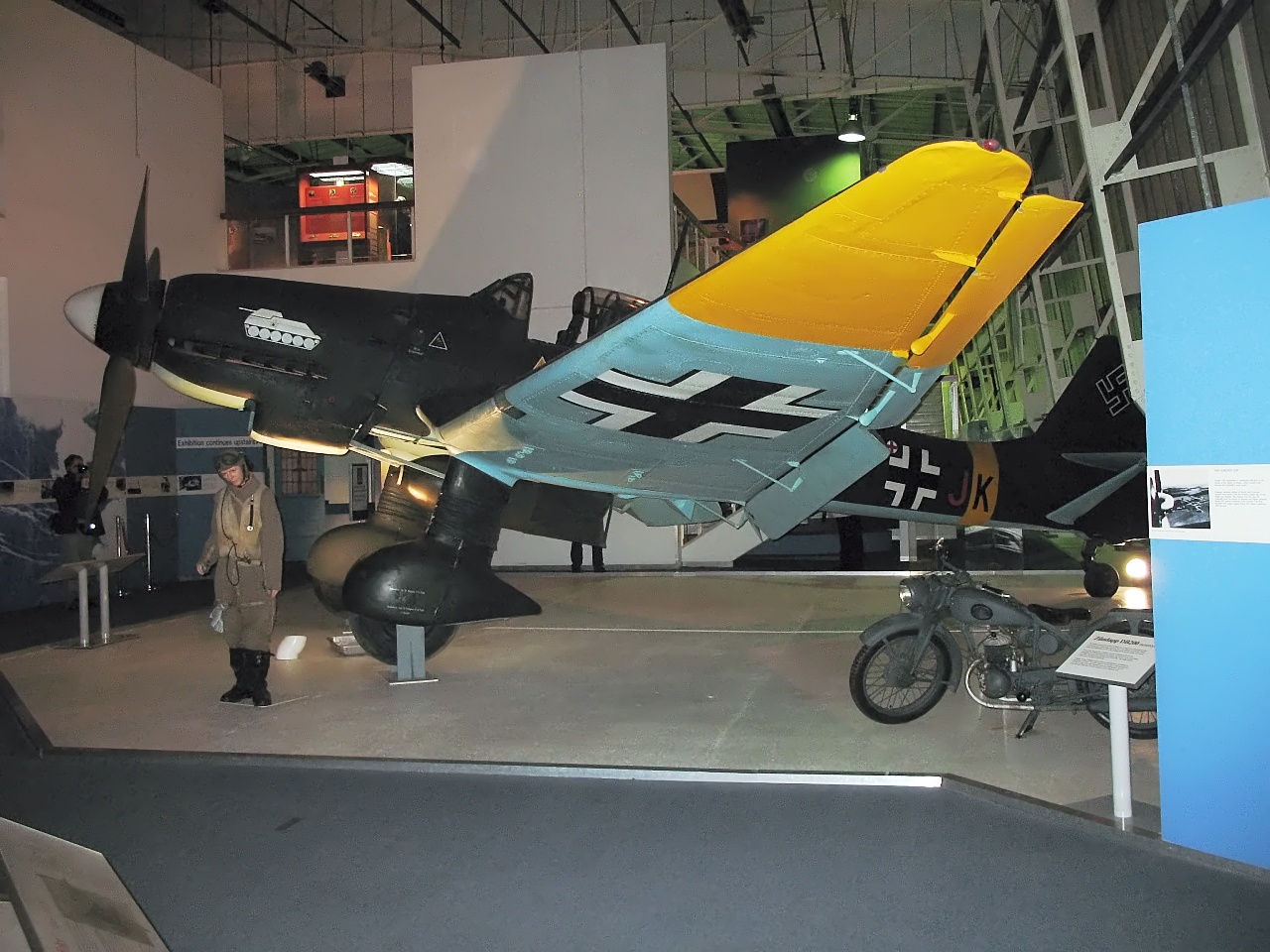
Junkers Ju 87 G-2, at the Museum of
Type: Dive Bomber
Manufacturer: Junkers-Flugzeugwerke
AGFirst flight: 1935
Introduced: 1936
Retired: 1945
Status: Retired
Primary users: Luftwaffe, Regia Aeronautica
Production: 1936-1944
May 1940.
Somewhere in France, the British convoy snaked along the dusty road. The truck, packed with soldiers whose faces the fighting has left their mark, they go to Calais, Dunkerque, at any point on the coast from which to embark for salvation. In the air, acrid plumes of smoke, dust and distant explosions, prevent them from forgetting the pincer inflexible German armored troops are inexorably closing in around them. Some doze in the rattle and purr of the tired engines of their vehicles and the groans of the wounded.
Suddenly all the faces are raised and tense. A low hum far as warning them. Soon, the dreaded thought becomes reality for them. No doubt are: Ju-87.
Stukas! It is the cry that crosses the lines of trucks and confusion broke out, the men abandoned their vehicles now traps fatal, in a desperate final attempt to avoid them howling about.
The Junkers 87, are dropped from the height of the British column. For the pilots of the German appliances are some whites to add to his already long list of goals accomplished.
The armored truck chosen, enlarged to the nose of the aircraft and the aircraft released their bomb runs on the convoy ground firing their machine guns.
The attack last few minutes, but it is devastating. Major road tunnels pierce the smoky remains of vehicles, are everywhere. The survivors, tired almost bovine undertake the long road to home ... or to captivity or death.
But Stuka is just short for the German word "Sturzkampfflugzeug" corresponding to a particular type of aircraft, "Dive Bomber" How then, became a synonym for an aircraft, the Junkers Ju- 87?
Years ago, in the United States before Germany was the National Socialist Reich, Ernst Udet, "as" German hunting in the great war with 62 victories, second behind the legendary Richthoffen the "Red Baron" in numbers of kills, present an extraordinary exhibition: the Export Curtiss Hawk II. Excited by the almost vertical chopped small device, Udet returned to Germany with two "Hawk" paid by Hitler's National Socialist Party, once in power, so as to aims to capture the nascent Luftwaffe.
In addition, it is to gain experience in the construction of the apparatus of assault, the latest and secret German military needs for its construction of the new war: Blitzkrieg or lightning war. Car units, airborne troops, will give the army its speed. The protection will be provided by aviation. The Stuka is thus the necessary apparatus. Almost say that it is superprecisa mobile artillery.
 Quickpost this image to Myspace, Digg, Facebook, and Others!
 development begins, the Curtiss were under severe time and again chopped. In one of these exhibitions Udet goes badly. Your machine is crashing to the ground shortly after leaving when he realized that would not chopping. By doing so at very low altitude, the parachute opens as poorly and give your bones on the floor. Fortunately, despite the loss of Curtiss is limited the damage to the pilot and testing continues. It concludes that above all, the unborn Stuka, must be robust, very robust, to withstand the hard efforts made to display in the field.
Your Entertainment * ground should be as easy as possible, since they will have to operate from areas poorly prepared to move forward with the armored armies.
speed dive and the pilot could support that too, is limited to 600km / h with air brakes.

 Quickpost this image to Myspace, Digg, Facebook, and Others!
 Quickpost this image to Myspace, Digg, Facebook, and Others!
 And the order goes to the German air industry, we must provide to the Luftwaffe, the name for the new Air Force dive bomber needs.
fair to say, before proceeding, if the program had the enthusiasm of the Nazis and German officers, also had his enemies, even within the gun area. Von Wolfframe Richthoffen, cousin of the aforementioned Red Baron and then head of the Development Section of the Technical Department of the Luftwaffe, believed that the Stuka would be a failure. Thought (rightly, as will be demonstrated) that the odds with strength is speed, which would make him easy prey for enemy fighters and precision would only be discharged from 1000 meters down ... which would be very well received by the flak defense. Moreover
could not carry too heavy a burden of war and therefore, its effects would not be definitive. Paradoxically, Richthoffen, commander of Stuka units later, contribute to the initial success of the Ju-87.
However, the program continues and has four aircraft industry in the country in the contest: the Arado Ar81, the Heinkel He118, the Ha137 Flugzeugbaus the Hamburger and the Junkers Ju87.
In 1936, Richthoffen has been replaced by Udet, ardent defender of the Stuka, as we know and the testing takes place.
The Ha137 not responds exactly to the specifications requested, since it is a car and is the closest game of leap that the Stuka, He118 crashed on a test (1) and Ar81 ... is a biplane.
The Stuka is finally a representative: the Junkers Ju-87 (2).
The first types in service, the Ju-87 A St. G. 162 "Inmelmann" (St. G. Geschwader-School Stuka Dive Bomber), later St. G. 2, made his first serves in arms when a Kette (patrol) of three of these devices was transferred in 1937 to the Legion.
* Maybe it relates to maintenance and not entertainment.
(1) Piloted by Udet himself and because of a failure this, that in their haste to get on the device do not pay enough attention to the explanations, they say before takeoff.
(2) Prior to and in an attempt might be called the first phase, the Luftwaffe was also equipped with dive bomber Henschel Hs-123, robust biplane had an outstanding performance in the conflict and assault aircraft almost to conclude this . Continue


